
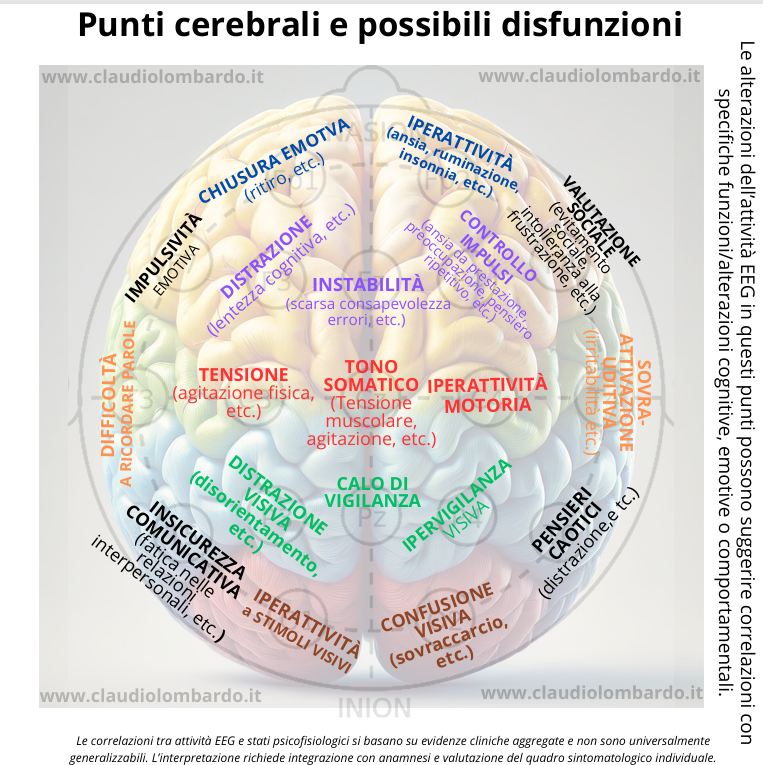
The 10–20 system: a map of the brain for EEG
The 10–20 system is an international standard used to position electrodes on the scalp during an EEG (electroencephalogram) recording. Its name refers to the distances between electrodes, calculated as percentages (10% or 20%) of the length of the head measured in the front-to-back and side-to-side directions.
Each point corresponds to a specific region of the cerebral cortex and is identified by a combination of letters and numbers:
-
The letters indicate the region (e.g. F = frontal, P = parietal, T = temporal, O = occipital, C = central and Fp = frontopolar).
-
The numbers indicate the hemisphere: odd numbers for the left hemisphere, even numbers for the right, and “z” for the midline.
This system makes it possible to monitor the brain’s electrical activity in functionally relevant areas, including those involved in:
-
attention and memory (frontal and central areas),
-
language and communication (temporal areas),
-
visual processing (occipital areas),
-
sensory processing and bodily integration (parietal areas).
In the context of neurofeedback, the 10–20 system makes it possible to accurately locate the areas to be observed or trained, based on the psychophysiological profile of the person.