
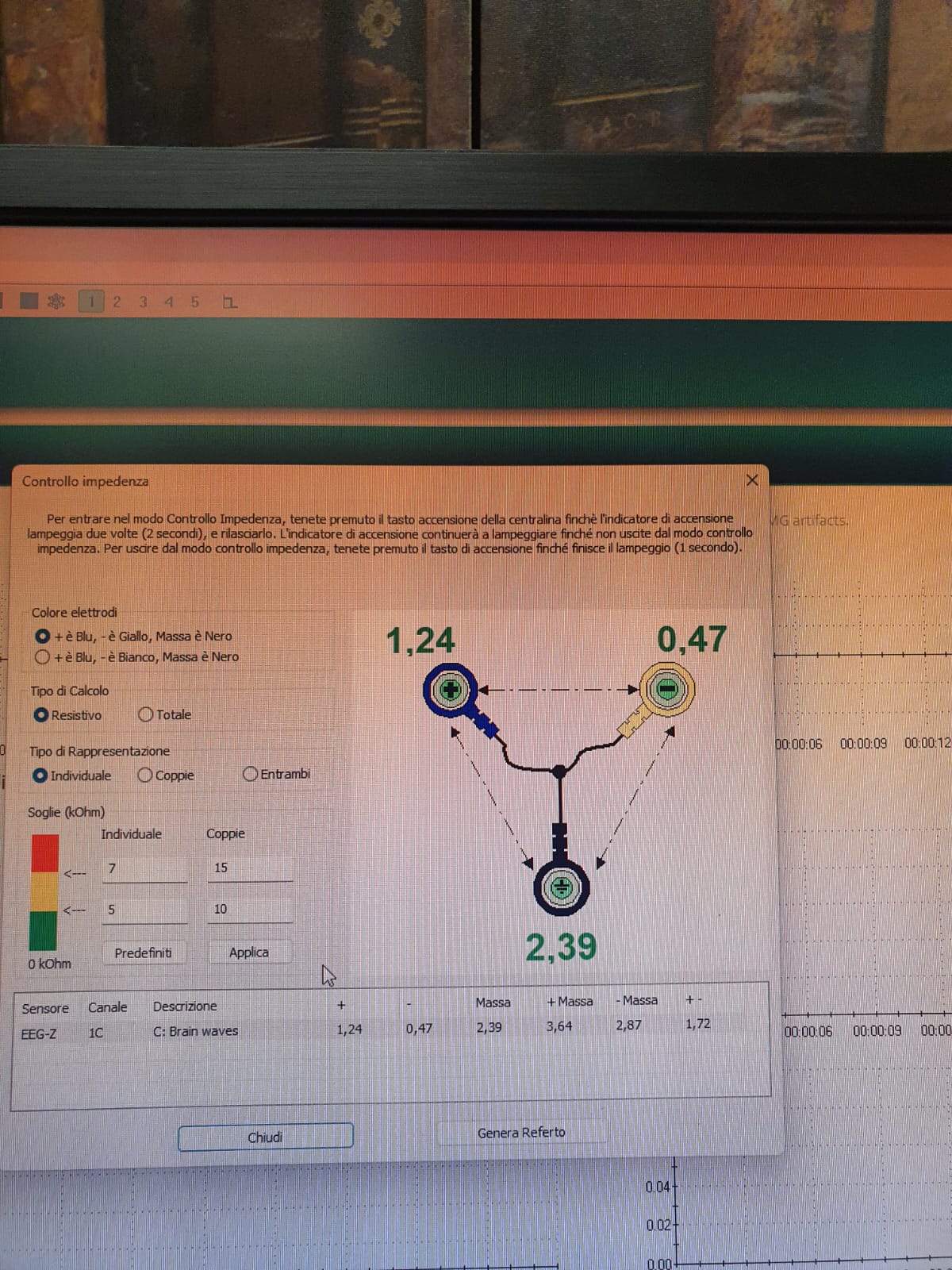
What is electrode impedance in neurofeedback?
In the context of neurofeedback, electrode impedance can be described as a kind of “gateway for the electrical signal” that should be easy to cross. Imagine water flowing through a pipe: if the pipe contains obstructions or deposits, the water does not flow properly. In the same way, impedance represents how difficult it is for the electrical signal to pass between the scalp and the electrodes.
What is impedance?
- Impedance is a measure of electrical resistance, but it goes beyond ordinary resistance: it also includes the system’s ability to handle alternating signals, such as brain signals.
- In neurofeedback, low impedance is essential for obtaining a clear and accurate signal.
Ground and reference electrodes: their roles
- Ground electrode:
- Think of the ground electrode as an “anchor” that stabilizes the electrical system.
- It is like the ground on which you build a house: it makes everything more stable and prevents the system from “floating” with noise or interference.
- Reference electrode:
- This electrode is the “starting point” used to compare electrical signals.
- Imagine measuring the height of a tree: you need to know where the “ground” (the reference) is before you can say how tall it is. The same applies to the brain: the reference provides a baseline from which its electrical activity can be assessed.
- Signal electrode:
- This is the “microphone” that listens to what the brain is doing at a specific location. To obtain a good recording, impedance between the skin and this electrode must be low.
Why is impedance important?
- Electrical noise: if impedance is too high, it is like having heavy static during a phone call: the real message is difficult to hear.
- Signal quality: low impedance helps ensure that the brain signal is not distorted.
- Interference: good impedance reduces interference from lights, cables and other electronic equipment.
How is impedance managed?
- Prepare the skin
- Remove the surface layer of dead skin cells and oils with conductive gel or gentle abrasion.
- It is like cleaning a window before looking through it: the cleaner it is, the better you can see.
- Use high-quality electrodes
- Well-designed electrodes made with conductive materials such as silver/silver chloride make it easier for signals to pass.
- It is like having a good antenna to receive a radio station: the better the quality, the better the transmission.
- Check impedance
- Neurofeedback systems often include an impedance meter that indicates whether the values are acceptable. Ideally, impedance should be below 5–10 kΩ; the lower, the better.
What happens when impedance is high?
- It is like trying to speak underwater: the message arrives distorted, weak or full of noise. In neurofeedback, this means that brain data may be misinterpreted or the brain may be trained incorrectly.
In summary:
- Ground is like the ground beneath your feet: it stabilizes everything.
- Reference is like a starting point: it tells you “where you are” in the signal.
- Low impedance is like a well-paved road: brain signals can travel without obstacles.
If you keep impedance low and position the electrodes correctly, neurofeedback will be like listening to a live concert instead of an old scratched record! 🎵
Why does impedance vary from person to person?
Impedance varies from one person to another because of individual biological and environmental differences. These are the main reasons:
1. Skin characteristics
- Skin thickness: thicker skin, or a more robust stratum corneum (outer layer), increases impedance and makes it more difficult for the signal to pass.
- Hydration: well-hydrated skin has lower impedance because water is a good conductor. Dry or dehydrated skin increases impedance.
- Natural oils: sebaceous glands produce oils that can create a barrier between the electrode and the skin, increasing impedance.
2. Age
- Skin changes with age: in younger people it is more hydrated and thinner, with lower impedance, while in older people it tends to be drier and thicker, which increases impedance.
3. Perspiration
- Perspiration contains conductive salts and can reduce impedance. Some people perspire more readily or more heavily than others, which affects the result.
4. Medical conditions and medication
- Damaged or irritated skin: scars, dermatitis and other conditions can alter conductivity.
- Medication: some medicines can make the skin drier or affect perspiration.
5. Skin preparation
- Cleaning and preparing the skin have a major effect. If the skin is not adequately cleaned or prepared, for example with conductive gel, impedance may be higher.
6. Genetic factors
- Genetics can determine unique skin characteristics, including oil production, the structure of sweat glands and the composition of perspiration, all of which affect conductivity.
7. Environmental factors
- Humidity and temperature: a warm, humid environment helps the skin remain hydrated, while a cold, dry environment makes it more dehydrated and increases impedance.
In summary:
Impedance varies from person to person because everyone has “unique skin” shaped by age, hydration, genetics, health and environmental conditions. Preparing the skin properly and monitoring impedance are essential steps for ensuring good signal quality in neurofeedback.