
NEUROFEEDBACK PARADOXES
The surprises of neuroplasticity!
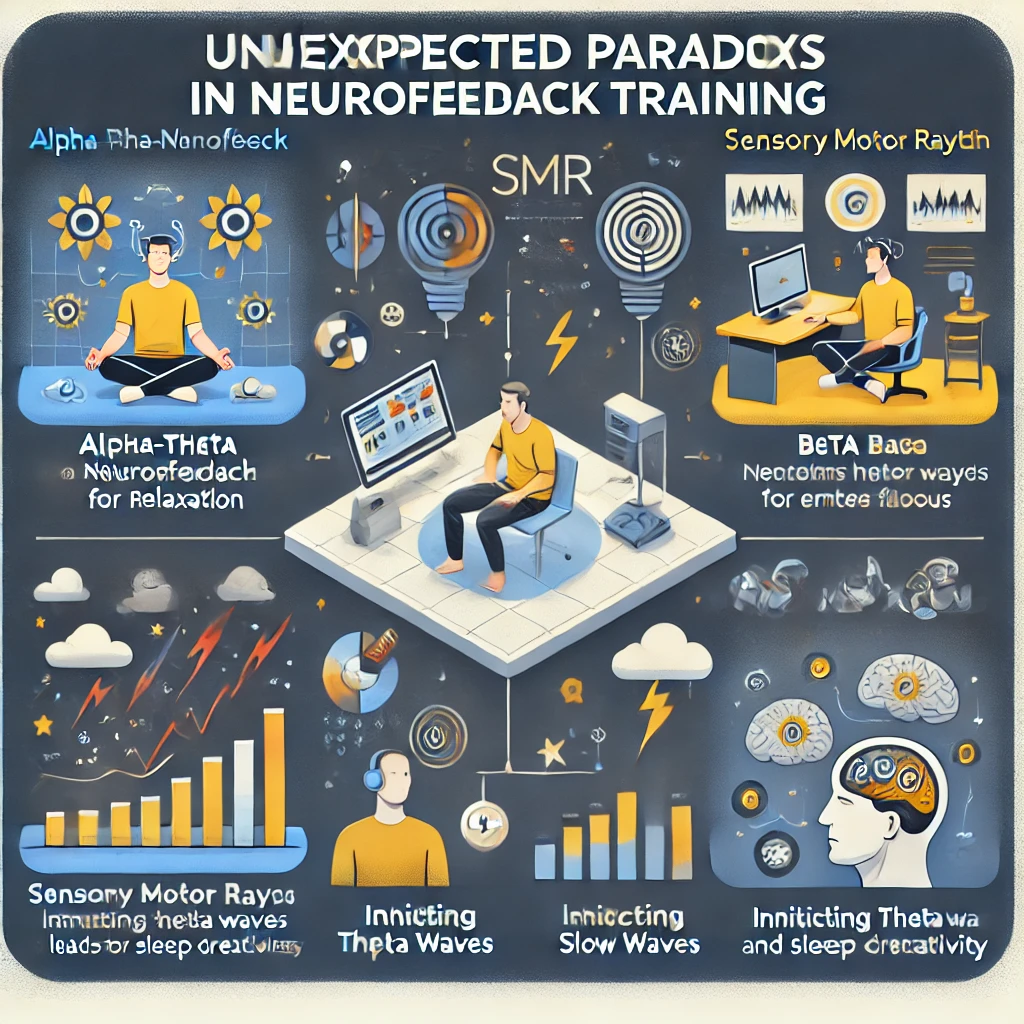
Neurofeedback works on brain waves, but the brain can respond in unexpected ways.
– Alpha-Theta training that increases anxiety instead of reducing it
-
A participant undergoes Alpha-Theta neurofeedback for relaxation, but feels more irritable and anxious after the session.
-
Possible explanations:
✅ Too much Theta without enough Alpha → can encourage uncontrolled introspection or intrusive thoughts.
✅ Some individuals do not tolerate altered states of consciousness well and the brain perceives the effect as destabilizing.
– Increasing SMR leads to mental fatigue instead of vigilance
-
SMR training (12-15 Hz) should improve concentration, but the subject feels tired.
-
Possible explanations:
✅ The brain is overloading its regulatory systems and a rebound effect occurs.
✅ The subject already has naturally high SMR activity and the further increase brings it into a state of “cognitive rigidity”.
– Beta training to improve attention causes anxiety
-
The subject does Beta training (15-20 Hz) to increase concentration, but they become more anxious.
-
Possible explanations:
✅ Too much Beta without sufficient balance with Alpha → leads to cognitive overload.
✅ The subject is already naturally hyperactive and increasing Beta worsens the anxious state.
– Theta reduction leads to insomnia instead of greater concentration
-
The training inhibits Theta to improve focus, but the subject has difficulty sleeping at night.
-
Possible explanations:
✅ Theta is essential for relaxation → its excessive reduction can alter sleep regulation.
✅ The brain can compensate by also reducing Delta, disturbing the natural cycle of sleep.
Conclusion: how to manage paradoxes
✅ Customize your training → Every individual has a unique neurophysiological profile and may respond differently.
✅ Monitor the effects after each session → If undesired responses occur, adjust the protocol.
✅ Integrate multiple measurements → HRV, EEG, and subjective feedback must be interpreted together.
✅ Avoid forcing the process → If a training protocol provides no benefit, it may not be suitable for the subject.