
TRAINING AND RELATIONSHIPS BETWEEN BRAIN-WAVE BANDS FOR SPECIFIC MENTAL STATES
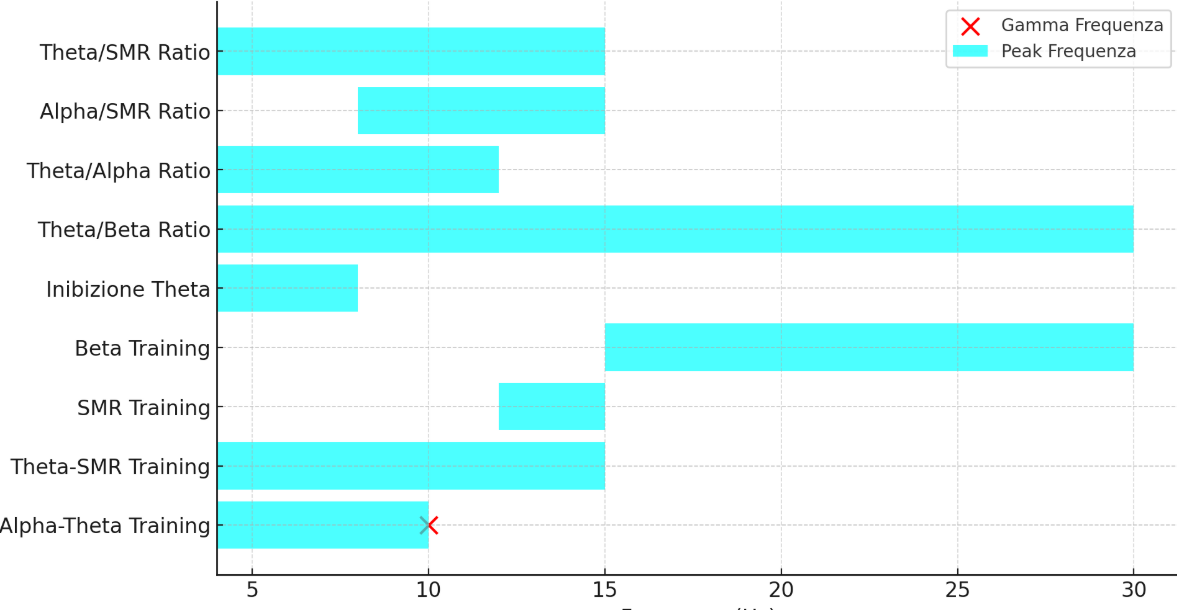
Every brain frequency band is associated with a specific mental state
Brain activity consists of different wave frequencies, each associated with specific cognitive, emotional and physiological states. Neurofeedback uses training protocols to optimise the balance between these waves, improving brain regulation.
Below, we analyse the main protocols and relationships between bands for cognitive enhancement, stress management, emotional regulation and improved focus.
🔹 Peak Alpha
📌 Definition: The Alpha peak is the dominant frequency within the Alpha band (8–12 Hz). The optimal value is around 10 Hz, but may vary between 8 Hz and 12 Hz depending on age and state of mind.
✅ Optimal (~10 Hz) → State of relaxed alertness, creativity and mental balance.
❌ Low Alpha peak (~8 Hz) → Associated with depressive states or cognitive slowdown.
❌ High Alpha peak (~12 Hz) → It can be linked to mental hyperactivity or anxiety.
👉 Training:
-
If the Alpha peak is too low, neurofeedback training can increase this frequency to improve mental clarity.
-
If the Alpha peak is too high, it can be useful to rebalance Beta activity to support better focus.
🔹 Alpha-Theta Training
📌 Objective: Induce deep relaxation and access states of inner awareness. Used for stress management, trauma processing and creativity.
🔹 How does it work?
-
Increases Theta waves (4–8 Hz), associated with implicit memory and creativity.
-
Reduces conscious control through modulation of Alpha waves (8–12 Hz), facilitating access to deep memories.
-
Can activate the unconscious reprocessing mechanism (similar to the REM stage of sleep).
❌ Risks: If the subject has a dissociative tendency, the training must be conducted with caution to avoid detachment from reality (Australian Effect/Alpha-Theta Flip).
🔹 Theta-SMR Training
📌 Objective: Reduce excessive Theta activity and increase SMR (Sensorimotor Rhythm, 12–15 Hz) to improve attention, motor regulation and sleep quality.
🔹 Applications:
✅ ADHD and attention deficits (to reduce Theta and increase SMR).
✅ Sleep disorders (increasing SMR improves sleep stability).
✅ Improvement of concentration and cognitive performance.
👉 Training:
-
Decrease in Theta waves (4–8 Hz) → Reduces distraction and daydreaming.
-
Increase in SMR (12–15 Hz) → Promotes stable attention and improves motor control.
🔹 SMR Training (Sensorimotor Rhythm)
📌 Objective: Improve motor control, attention stability and deep sleep.
🔹 Applications:
✅ Reduces hyperactivity in children with ADHD.
✅ Improves sleep quality, reducing night awakenings.
✅ Useful for athletes and musicians to improve motor control.
👉 Training:
-
Increase in SMR (12–15 Hz) in the sensorimotor cortex → Better regulation of movement and improved sleep quality.
🔹 Beta Training
📌 Objective: Increase Beta activity (12–30 Hz) to improve attention, logic and cognitive performance.
🔹 Applications:
✅ Improve concentration and mental processing speed.
✅ Optimise brain function for complex tasks.
✅ Used in subjects with ADHD to improve cognitive responsiveness.
👉 Training:
-
Increase in Beta waves (15–20 Hz) → Improves concentration and working memory.
-
But be careful: an excess of Beta can lead to anxiety and hyperactivation.
RELATIONSHIPS BETWEEN BRAIN-WAVE BANDS AND MENTAL STATES
🔹 Theta Inhibition
📌 Objective: Reduce excessive Theta activity (4–8 Hz), typically seen in people with poor attention, drowsiness or mental disorganization.
🔹 Applications:
✅ ADHD and cognitive difficulties.
✅ Excessive daydreaming and poor focus.
✅ States of uncontrolled trance or dissociation.
👉 Training:
-
Decrease Theta and increase Beta or SMR to improve vigilance.
🔹 Theta/Beta Ratio
📌 Meaning: The relationship between Theta (4–8 Hz) and Beta (15–30 Hz) is an indicator of balance between relaxation and attention.
✅ Low Theta/Beta Ratio → Improved concentration and mental readiness.
❌ High Theta/Beta Ratio → Associated with difficulty sustaining attention and drowsiness, typical of ADHD.
👉 Training:
-
Reduce Theta or increase Beta to improve concentration.
🔹 Theta/Alpha Ratio
📌 Meaning: Indicates the relationship between relaxation (Alpha) and dreamlike or dissociative states (Theta).
✅ Low Theta/Alpha Ratio → Alert and present state.
❌ High Theta/Alpha Ratio → It may suggest dissociative states or mental hyperactivity (Alpha-Theta Flip).
👉 Training:
-
If the Theta/Alpha ratio is too high, it can be useful to increase Alpha and reduce Theta to maintain a better connection with reality.
🔹 Alpha/SMR Ratio
📌 Meaning: Shows the balance between relaxation (Alpha) and focused attention (SMR).
✅ Balance → Stable mental state between relaxation and vigilance.
❌ High Alpha/SMR Ratio → Tendency towards passivity and reduced responsiveness.
👉 Training:
-
If Alpha is too high compared to SMR, it can be useful to increase SMR to improve concentration.
CONCLUSION
💡 Relationships between brain bands affect attention, emotional regulation, memory and psychophysical well-being.
💡 Personalised neurofeedback helps rebalance these frequencies, improving cognitive functions and mental well-being.